If you’ve ever stepped out of a rental go kart at Picton Karting Track wondering how close that rush gets to owning your own race kart, you’re asking the right question. Most people assume there’s a huge difference between “rental karts” and “real competition karts”—especially popular club-racing setups like the Briggs & Stratton LO206 and Rotax 125 MAX.
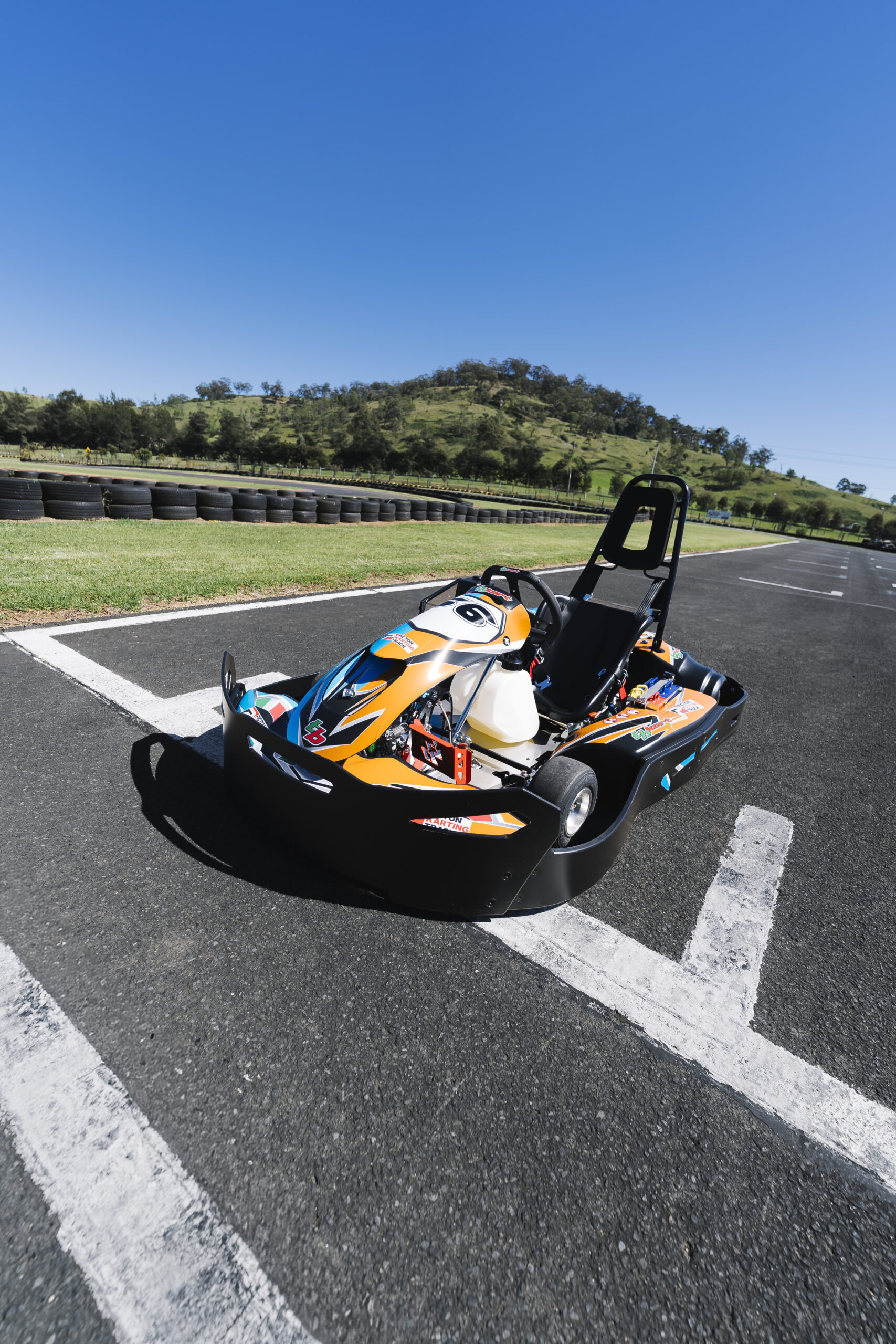
Lets have a look of the breakdown between our karts and race karts. The biggest surprise for most drivers who visit us at Picton is that our fleet isn’t made up of slow, heavy rental go karts. Because we run on a 640-metre outdoor circuit, our karts are built on proper Italian TB Kart chassis designed for outdoor grip and real cornering loads.
PKT’s 18HP Fleet vs. the Briggs & Stratton LO206
In club karting across Australia and around the world, the Briggs & Stratton LO206 is the standard for grassroots, four-stroke competition racing. It is a four-stroke racing engine producing around 9 horsepower, paired with a strict 6,100 RPM digital rev limiter. The entire philosophy behind the Briggs 206 is parity: nobody can spend thousands of dollars modifying their engine, and nobody can out-rev the competition. When every engine hits the exact same revs races are won purely on braking zones, cornering speed, and race craft.
How PKT’s 18HP Fleet Uses That Exact Same Philosophy
At Picton Karting Track, we apply that exact same motorsport principle to our 390cc fleet, just with double the horsepower under your right foot. On a standard commercial hire kart, engines are choked down with mechanical governors, restrictive stock exhausts, and hard, long-life tyres. We strip all of that away:
- Governors Removed & Digitally Limited: Just like a competition Briggs LO206 uses a digital ignition limiter to keep the grid even, we remove the mechanical governors on our 390cc engines and fit them with a digital rev limiter set to 5,200 RPM. This eliminates engine surge, gives you crisp throttle response all the way down our 190-metre main straight, and guarantees every kart in the fleet hits the exact same peak performance.
- Real Racing Hardware: Our 18HP karts are fitted with free-flowing TB performance exhausts, open-air filters so the engines can breathe at higher RPMs, and soft-compound MG racing tyres—the same brand of rubber you’ll find on competition karts worldwide.
- Momentum Driving: Because both the Briggs LO206 and our 18HP fleet rely on digital rev limiters, they reward the exact same driving style. You can’t rely on endless top-end revs to bail you out of a sloppy corner. Smooth inputs, late braking, and carrying minimum corner speed are everything.
Stepping Into the 2-Stroke Arena — PKT’s 23HP RMAX vs. Competition Rotax Karts
If our 18HP 390cc karts mirror the equal racing conditions of a four-stroke Briggs LO206, our 23HP RMAX fleet crosses directly into genuine two-stroke competition territory. At PKT, we run Australia’s only fleet of 23HP TB KART RMAX karts. Rather than a modified industrial engine, these are powered by an authentic Austrian-built 125cc Rotax MAX liquid-cooled two-stroke racing engine—the exact same engine used in worldwide karting competitions.
23HP RMAX Technical Specifications
- Engine: 125cc Rotax MAX 2-Stroke (23 HP, liquid-cooled)
- Max RPM: Up to 14,000 RPM (unrestricted two-stroke powerband)
- Top Speed & Acceleration: 110 km/h top speed
- Chassis: Italian lightweight TB KART RMAX race chassis
- Braking System: Self-adjusting hydraulic rear brake system with ventilated brake disc
- Tyres & Wheels: Reinforced aluminum wheels wrapped in soft-compound MG racing tyres
How to Qualify: 23HP RMAX Driver Rules & Requirements
Because a 14,000 RPM two-stroke kart demands sharp braking markers, smooth throttle control, and high track awareness, drivers cannot jump straight into the 23HP RMAX on their first visit. To ensure safety and competitive racing on our 640-metre outdoor circuit, all drivers must meet strict eligibility and qualifying criteria:
- Age, Height & Weight Limits: Drivers must be 17 years of age or older, at least 1.4 meters tall, and weigh no more than 130 kg.
- Mandatory 18HP Qualifying Sessions: All drivers must first complete at least 2 qualifying races in our 18HP 390cc karts.
- Track Craft & Safety Assessment: During your 18HP sessions, PKTs staff will evaluate your lap consistency, cornering lines, braking discipline, and safe overtaking. You must demonstrate that you can drive with both speed and caution before being cleared for the 23HP fleet.
- Pre-Race Briefing: Once qualified, drivers complete a dedicated two-stroke safety and handling briefing before hitting the track.
The Full Lineup: PKT Fleet vs. Competition Race Karts
| Feature | PKT 18HP (390cc) | Competition Briggs LO206 | PKT 23HP RMAX | Competition Rotax Junior / Senior MAX |
| Engine Type | 4-Stroke (Tuned) | 4-Stroke Sealed Race Engine | 125cc Rotax MAX 2-Stroke | 125cc Rotax MAX 2-Stroke |
| Horsepower | 18 HP | 9 HP | 23 HP | 23 HP (Junior) / 30 HP (Senior) |
| Rev Limiter / Max RPM | 5,200 RPM Digital Limiter | 6,100 RPM Digital Limiter | Up to 14,000 RPM | Up to 14,000 RPM |
| Top Speed (at PKT) | 75 km/h | 85 km/h | 110 km/h | 120 km/h |
| Chassis & Protection | TB KART w/ Roll Bar & Harness | Lightweight Open-Wheel Sprint Chassis | TB RMAX Race Chassis + Full Surround Bumper | Lightweight Open-Wheel Sprint Chassis |
| Tyres | Soft-Compound MG Race Tyres | Hard/Medium Spec Race Tyres | Soft-Compound MG Race Tyres | Mojo / Vega / MG Race Tyres |
| Eligibility & Cost | Ages 17+ / Arrive & Drive | Motorsport Licence + $5k–$10k+ Setup | Ages 17+ / 2x 18HP Qualifying Races | Motorsport Licence + $10k+ Setup + Rebuilds |
Book your next session at Picton Karting Track, clock your 18HP qualifying laps, and step up to Australia’s only 23HP Rotax RMAX fleet.