
Every second on an outdoor track comes down to how your machine responds to your inputs. To master your racing lines and drop your lap times, you need to understand what happens underneath the seat.
This complete go-kart parts guide by the team at PKT breaks down the essential mechanical systems that drive a racing kart. Whether you’re a casual renter or a seasoned racer chasing a personal best, knowing these core systems changes how you approach every corner.
Quick go-kart parts guide
| Core Part | Primary Role | Key Elements |
| Engine | Generates power and acceleration | Carburettor and clutch |
| Chassis | Structure and controlled flex | Chrome-moly frame |
| Brakes | Controls deceleration and entry speed | Calliper and brake rotor |
| Tyres | Connects the kart to the track surface | Slick or treaded tyres |
Go-kart parts explained
To get the most out of your track days, breaking down the vehicle into its primary components helps you understand kart handling. Let’s look at the four major areas that dictate performance on the bitumen.
1. Engine
The motor provides the raw power that propels you down the straightaways. Go-kart engines generally fall into two categories, each offering a distinct feel:
- Four-stroke engines — These motors offer reliable, steady torque. They are excellent for learning precise pedal control and maintaining momentum.
- Two-stroke engines — These high-performance models deliver massive acceleration and high RPMs for pure racing speed.
Inside the engine bay, the carburettor mixes air and fuel while the clutch transfers power to the rear axle when accelerating.
2. Chassis
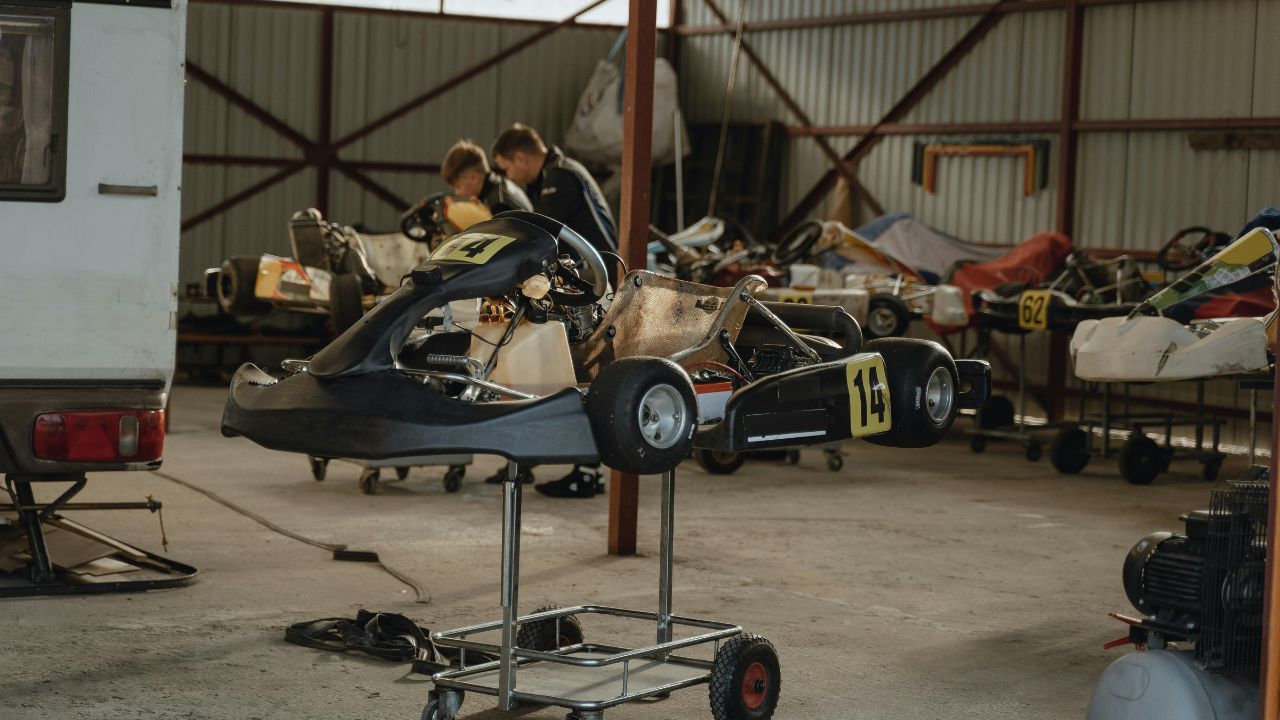
If the engine is the heart, the chassis is the backbone. Unlike road cars, a racing kart lacks a traditional suspension system with springs. Instead, the chrome-moly steel frame flexes naturally to maintain grip and stability while cornering.
The steering mechanics are equally direct. Spindles and tie rods connect the steering wheel straight to the front wheels. You can see this engineering in action when you look at our modern hire karts, which feature world-class Italian frames built for exceptional handling.
3. Brakes
When aiming for fast lap times, slowing down is just as important as accelerating. Most karts utilise a rear hydraulic disc brake system that is highly sensitive. When you press the left pedal, the mechanical process follows a specific order:
- The master cylinder forces fluid through the lines.
- Pressure reaches the calliper housing the brake pads.
- The pads clamp tightly onto the spinning rotor.
Because the brakes lock the rear axle, aggressive braking can cause slides. Test your braking precision on the sharp hairpins outlined in our complete track statistics to see how proper deceleration keeps your engine RPMs high and stabilises the chassis.
4. Tyres
Tyres are the only contact point between the kart and the bitumen. They dictate how much power you can put down and how much cornering speed you can carry through a bend.
- Slick tyres — Used for dry conditions, these tyres have no tread to maximise track contact. Heated rubber becomes sticky and provides immense grip.
- Rain tyres — If conditions turn wet, drivers swap to treaded tyres that clear water away to prevent aquaplaning.
Overheated rubber loses grip and causes the kart to slide, which can instantly ruin your momentum.
Race smarter, go harder at Picton Karting Track
Having all these go-kart components explained can give you a distinct advantage on the starting grid. Every single element, from the go-kart’s engine, chassis, brakes and tyres to the steering linkages, works in perfect harmony to deliver a responsive driving experience.
Now that you’ve seen these essential go-kart parts explained, it’s time to put this knowledge into practice. Gather your friends or colleagues for our team endurance racing events to see who can manage their machinery best. Book your track session today and feel how these components work together to shave tenths off your lap time.